EDEN PRAIRIE, MINN. — If you’ve ever shopped for shelf-stable broths, purchased chewy fruit snacks, or ordered coffee with an alternative milk — like oat, almond, coconut or soy, for example — then you’ve likely tasted something made by SunOpta.
The company is a contract and private label manufacturer for several of the largest food and beverage brands, making aseptic plant-based beverages, fruit snacks, ready-to-drink protein shakes and broths. While you won’t see SunOpta’s name on a label, their reach is wide within those categories, and continues to grow.
The company’s recent second-quarter revenues grew 13%, and even with a $1.6 million dollar hit due to tariff expenses, SunOpta chief executive officer Brian Kocher said the second quarter was “a really good quarter that could have been better.”
Food Business News interviewed Kocher recently to discuss what consumer and customer desires are driving the growth of SunOpta’s sales, spurring its recent $25 million investment in a new production line for fruit snacks at its Omak, Wash., facility to keep up with exponential demand for fruit snacks across multiple sales channels.
Food Business News: SunOpta has seen double-digit growth in its fruit snacks business over 20 consecutive quarters. What’s driving that upward trajectory?
Kocher: The trend of better-for-you products. This is a product that looks like a fruit strip or gummy bear or something of that nature, but is made from apple juice and apple puree, for example. It has a clean label with zero artificial flavors or artificial colors. It’s absolutely in that better-for-you category. Second, the portability really helps. Each one of these fruit snacks is in its own individual wrapper. They’re sold in 12 packs or 26-count packs, 40-count packs, and they’re portable so you can drop them in a purse, in a lunch box, in a briefcase, whatever it is.

“Our plant-based products have now become the core ingredients of permanent menu items,” said Brian Kocher, SunOpta CEO.
| Photo: SunOptaIf you look at snacking overall, I’d say over the past several quarters it’s soft to flat. But if you look at that better-for-you sub-segment of snacking, it continues to grow 20% plus, and I think it’s associated with all those factors I mentioned: on-trend, better for you, clean label and it tastes good. When you hit those four characteristics, you have a lot of runway.
As we look long-term at the continued growth of fruit snacks, we’ve got more room in Omak, and we have room for more production lines in our Niagara, Canada facility as well.
FBN: What sort of equipment is going into the new production line at your Omak facility for fruit snacks, and from a wider lens, how does SunOpta approach Capex investments like this one?
Kocher: This $25 million expansion is a full line. We have a batching system with a boiler that cooks and mixes the product, we cool it in an evaporator, and we extrude it into the desired format, like strips or twists or bars, then cut it and send it through a cooling tunnel so it cools off and then we wrap it and pack it.
We spend around $30 million to $35 million a year in what we call maintenance and productivity Capex. Every single year we’re investing in our network to make sure it’s efficient, that it’s operating appropriately and properly, and that we’re improving our quality.
We have a lot of growth we can service by improving the operating effectiveness of our existing networks and we’re doing a great job at that. We improved output at our aseptic manufacturing facilities 16% in the second quarter versus the second quarter of 2024, and 22% in our fruit snacks facilities. We’re getting more productivity out of our existing assets, but with the categories growing the way they are, eventually we’ll need to invest in some growth Capex.
FBN: SunOpta’s aseptic beverage and broth production also is seeing steady growth. What are the factors driving sales in plant-based milk, for example?
Kocher: There are a lot of different structural tailwinds behind growth in the category. A large preponderance of the product is consumed in foodservice establishments. Those are areas where consumer behavior is routinized a bit. If you go to your favorite coffee shop on Tuesday, Wednesday and Thursday every week and you get your latte, that’s not considered a luxury really.
Another thing that’s changed in foodservice over the last several years is that our plant-based products have now become the core ingredients of permanent menu items, and that assortment mix has continued to fuel the category. For instance, if you order an oat milk latte, you don’t say, “Can I have oat milk in my latte?” The product you’re ordering is the finished product on the menu.
Broth continues to grow, especially to health-conscious consumers, and it’s a versatile product with more recipes using broth as the base. (Aseptic, shelf-stable) broth also gives us flexibility in production. If we have an open production window in May for example, we can produce broth and store it in inventory until Halloween. Broth gives us an opportunity to smooth out production variability, and it has become very strategic for us on our operation side.
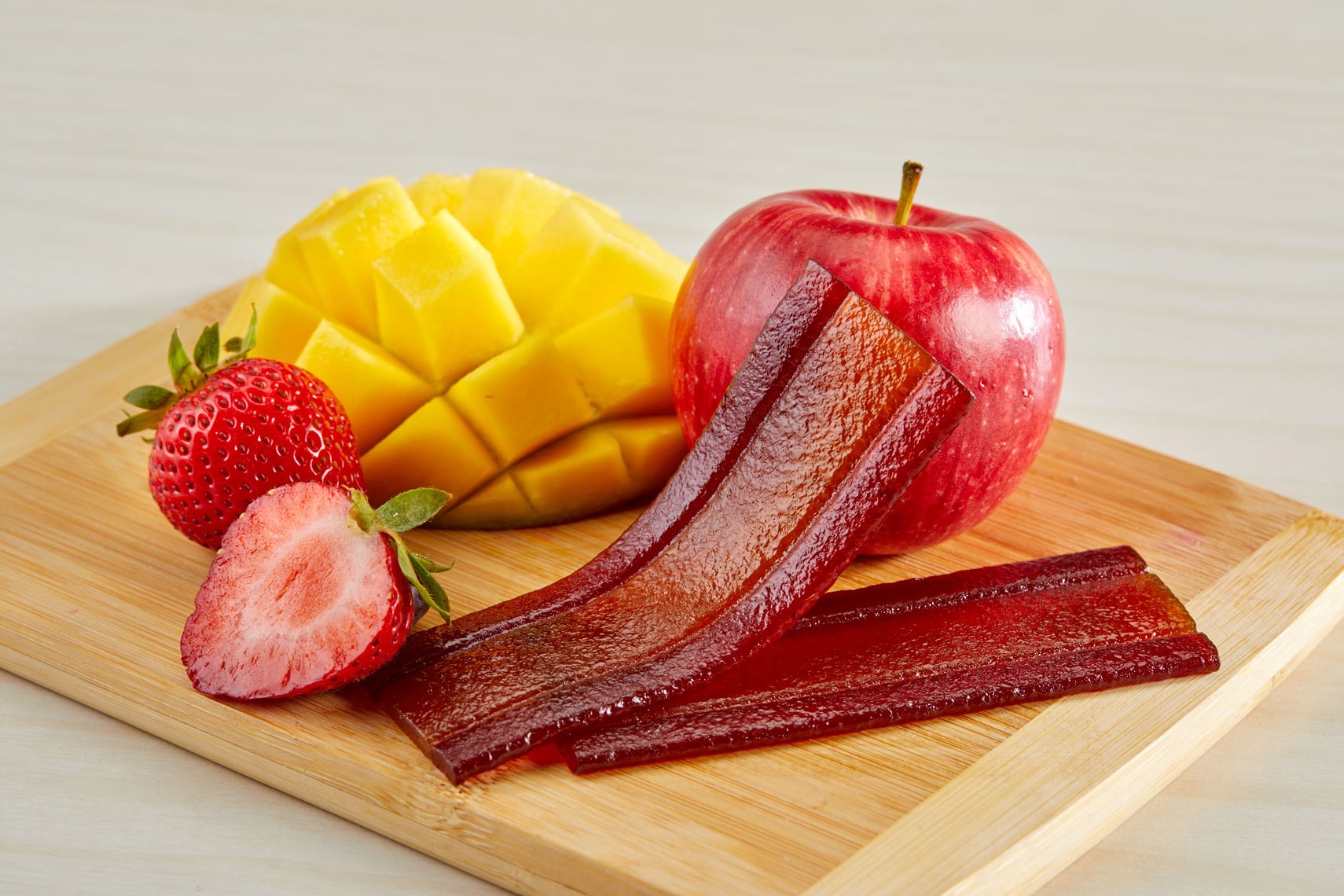
Fruit snacks at SunOpta are extruded into shapes like strips, twists, bars and more, then cut and packaged for customers.
| Photo: SunOptaFBN: In SunOpta’s recent second-quarter earnings results, you mentioned the company took a $1.6 million hit from tariff expenses due to a lag on pass-through pricing with your customers. Can you explain SunOpta’s short-term and long-term approach to tariffs?
Kocher: For many years we’ve had agreements with our customers that allow us to pass through changes in raw product prices if raw products go up. When it comes down, we actually pass along the decrease in the raw product prices, too. In a way tariffs are another form of raw product price volatility. I would say that muscle is very well exercised in our business and in our organization, so we’re able to pass through pricing in the short term.
Longer term, I think we have options and opportunities to change the country of origin in certain of our raw products to ensure we have less of a tariff impact. It may come at a cost in the supply chain. Even if we were able to get to a point where we were tariff free on many of our products, it still might be a little bit higher overall in terms of the supply chain because we maybe need new equipment to process a different format of the raw product. There may be a cost associated with that, but we do have separate work streams associated with trying to address long term the origination of the tariff.
FBN: Sustainability programs for some companies have become less of a priority due to the perceived cost/benefit of those programs, and the desire to focus resources on more immediate business concerns. How does SunOpta balance its business needs with environmental responsibility today?
Kocher: It isn’t a separate program — it’s part of our business. We save water because it’s efficient to save water in our operations and it’s good for the communities where we work and live.
Our business projects are ESG (environmental, social, governance) projects and I think that’s when it makes the most sense. Our projects are employee driven, and we get a lot of employee suggestions that say we have an opportunity to save water, save electricity, make a bigger impact.
We’re going to complete a couple of life cycle assessments over the next several years. We’ve got initiatives across water, greenhouse gas emissions and waste. Five of our seven (production) facilities are zero-waste facilities. We’re quickly trying to get our Modesto (Calif.) facility back to a zero-waste facility, and then our Midlothian (Texas) plant shortly thereafter. Again, it’s all very consistent with the business initiatives we’re driving and that’s really exciting to me.