



Natural Organic Food Products & Ingredient Sourcing Company
2026 Top Sustainable Food System Types for Global Buyers?
As global buyers reassess food supply chains in 2026, sustainable food systems are becoming a practical sourcing priority. They connect farming, processing, transport, packaging, and waste reduction. The strongest models do more than protect soil and water. They also support reliable yields, fair producer incomes, food safety, and transparent reporting. Buyers may encounter regenerative agriculture, agroforestry, controlled-environment farming, certified organic production, alternative proteins, and regional circular food networks. Each system offers useful advantages. None is perfect.
Real purchasing decisions require evidence, not attractive claims. A buyer might examine soil-carbon records, irrigation data, pesticide controls, labor standards, traceability systems, and third-party certifications. A tomato grown in a water-efficient greenhouse may reduce transport emissions, yet its energy source still matters. A regenerative farm may improve soil structure, but results can vary by climate, crop, and measurement method. These details influence long-term value. They also expose uncomfortable gaps in current sustainability reporting.
This overview introduces the leading sustainable food systems expected to influence global sourcing in 2026. It considers scalability, resilience, cost, verification, and regional suitability. Practical examples will show how these systems perform beyond marketing language. Some claims will remain difficult to compare. That uncertainty deserves attention. Buyers should ask who collected the data, how often it was checked, and what was excluded. Responsible sourcing is not a single technology or certificate. It is a continuous process of testing assumptions, improving outcomes, and accepting that better food systems still require honest correction.
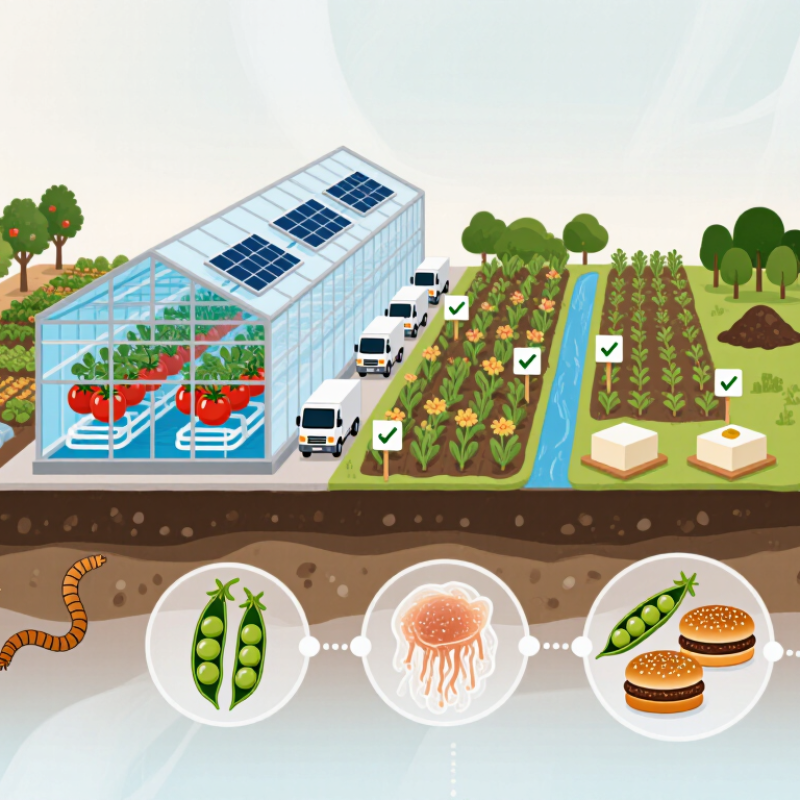
What Defines a Sustainable Food System in 2026?
What Defines a Sustainable Food System in 2026?
A sustainable food system connects healthy diets, resilient farms, fair labor, and lower environmental pressure. It is not simply organic, local, or plant-based. Buyers should examine how food is grown, processed, transported, sold, and consumed. The FAO estimates that agrifood systems generate about one-third of global greenhouse gas emissions. That figure makes emissions tracking essential, but carbon alone is incomplete. Water use, soil health, biodiversity, nutrition, and worker safety also matter. A sustainable system should produce food reliably without exhausting tomorrow’s resources.
The strongest models combine regenerative farming, efficient controlled environments, circular food production, and responsible fisheries. Their value depends on measurable results, not attractive claims. UNEP reported that households, food services, and retailers wasted 1.05 billion tonnes of food in 2022. This represents nearly one-fifth of food available to consumers. Buyers can therefore assess storage losses, packaging performance, by-product use, and disposal rates. Traceability should reach farms and processors, with independently verified data where possible. Still, no model is perfect. Digital monitoring can improve accountability, yet it may exclude smaller producers lacking expensive technology.
Tips: Request farm-level evidence, water and emissions data, and clear welfare standards. Compare results against recognized reporting frameworks. Check whether improvements continue across multiple seasons. Ask difficult questions about waste, labor conditions, and supplier access. A low-impact label means little without transparent measurement.
2026 Top Sustainable Food System Types for Global Buyers
What defines a sustainable food system in 2026? The table compares scalable food-system models using environmental, social, resilience, traceability and procurement criteria.
| Food System Type | 2026 Buyer Priority | Core Definition | Primary Sustainability Advantages | Evidence-Based Reference Data | Recommended Buyer KPIs | Verification and Traceability | Main Constraints | Best-Fit Purchasing Categories |
|---|---|---|---|---|---|---|---|---|
| Regenerative Agriculture | High | Farming that aims to improve soil health, biodiversity, water retention and farm resilience through practices such as cover cropping, reduced soil disturbance, crop diversification and managed grazing. | Can improve soil organic matter, reduce erosion, support biodiversity and improve water infiltration when practices are appropriate to local conditions. | Agriculture uses about 70% of global freshwater withdrawals; soil and water stewardship are therefore material procurement issues for food buyers. | hectares under verified practices; soil organic carbon sampling; erosion risk; fertilizer and pesticide intensity; water-use intensity; biodiversity indicators. | Farm-level geospatial records, practice logs, soil tests, independent audits and outcome-based verification. | Results vary by climate, soil type and time period; carbon benefits should not be assumed without repeated measurements and permanence controls. | Grains, pulses, oilseeds, cottonseed, livestock feed, fruit, vegetables and ingredients sourced from defined agricultural regions. |
| Agroecological and Diversified Farming | High | Production designed around ecological processes, crop and livestock diversity, locally adapted varieties, natural pest control and reduced dependence on external inputs. | Supports agrobiodiversity, pollinators, local food resilience and potentially lower synthetic-input dependency. | The food system contributes approximately 31% of human-caused greenhouse-gas emissions, making diversified, lower-input production relevant to climate strategies. | Crop diversity; rotations; percentage of non-crop habitat; synthetic-input intensity; yield stability; farmer income and resilience. | Participatory guarantee systems, farm audits, field records, satellite monitoring and documented input inventories. | May require more management and region-specific knowledge; aggregation and consistent volume can be difficult for global procurement. | Specialty grains, pulses, spices, horticulture, cocoa, coffee, herbs and regionally sourced staples. |
| Certified Organic Production | High | Production governed by organic standards that restrict or prohibit specified synthetic inputs and genetically modified organisms, with requirements for ecological management and inspection. | Supports soil-management practices, input transparency and biodiversity objectives; certification creates a recognized procurement specification. | Global organic farmland reached approximately 96.4 million hectares in 2022, according to the global organic agriculture statistics reported by FiBL and IFOAM Organics International. | Certified hectares; audit status; prohibited-input compliance; soil fertility; biodiversity measures; yield and price premium; smallholder participation. | Accredited certification, chain-of-custody documentation, transaction certificates and residue testing where applicable. | Certification costs, supply limitations, yield variability and possible substitution or fraud risks in complex supply chains. | Fresh produce, grains, pulses, dairy, eggs, spices, tea, coffee, cocoa and processed organic ingredients. |
| Precision and Climate-Smart Agriculture | High | Data-enabled production that uses targeted irrigation, nutrient application, pest management, weather information, improved varieties and adaptive farm planning. | Can reduce excess fertilizer, pesticide and water use while improving productivity and resilience to heat, drought and changing rainfall patterns. | Nitrogen, phosphorus and potassium losses are important water-quality and emissions risks; measurement should focus on input intensity and nutrient-use efficiency rather than technology adoption alone. | Water per tonne; nutrient-use efficiency; pesticide application rate; fuel use; yield stability; avoided field emissions; percentage of fields digitally mapped. | Digital field records, calibrated sensors, satellite data, farm-management platforms and independent data-quality checks. | Requires connectivity, farmer training, capital investment and interoperability; data ownership and privacy must be clearly defined. | Large-volume grains, oilseeds, sugar crops, horticulture, irrigated crops and climate-risk-sensitive supply chains. |
| Circular Food Systems | High | Systems that prevent food loss, recover edible food, reuse by-products, recycle nutrients and return safe organic matter to soils through controlled biological processes. | Reduces waste, improves resource efficiency, lowers disposal impacts and can create additional value from unavoidable by-products. | Approximately 13% of food is lost before retail, while an estimated 19% is wasted at retail, food-service and household levels; global food waste was about 1.05 billion tonnes in 2022. | Food-loss rate; edible-food recovery rate; by-product utilization; waste diverted from landfill; recycled nutrient volume; energy and water used per recovered unit. | Mass-balance accounting, waste-stream measurement, HACCP controls, product traceability and documented end-use of recovered materials. | Food-safety regulation, contamination risk, logistics, inconsistent by-product quality and competition between feed, fertilizer and energy uses. | Processed foods, brewing and milling by-products, food-service procurement, animal feed ingredients, compost and bio-based ingredients. |
| Sustainable Aquatic Food Systems | High | Responsible capture fisheries and aquaculture managed to maintain aquatic ecosystems, protect workers and communities, and provide nutritious food with controlled environmental impacts. | Provides nutrient-dense food and can have a lower land footprint than many terrestrial systems when stocks, feed, water quality and labor conditions are well managed. | In 2022, aquaculture supplied approximately 51% of aquatic animals produced for human consumption, making farmed aquatic food central to future global supply. | Stock status; feed-conversion ratio; fish-in/fish-out ratio; antibiotic use; escape events; water quality; labor compliance; habitat impact. | Catch documentation, farm audits, vessel monitoring, species traceability, feed-origin records and chain-of-custody certification. | Overfishing, habitat conversion, disease, feed impacts, illegal fishing and weak enforcement in some producing regions. | Low-trophic species, responsibly farmed shellfish, certified fisheries, seaweed, freshwater fish and traceable seafood ingredients. |
| Controlled-Environment and Vertical Farming | Medium | Food production in greenhouses, indoor farms or vertical systems using controlled light, temperature, humidity, nutrients and irrigation. | Can reduce land use, shorten supply chains, limit pesticide exposure and reduce water use for selected high-value crops. | Water performance should be reported as litres per kilogram of marketable product; total environmental performance depends heavily on electricity source, cooling and infrastructure materials. | Energy per kilogram; renewable electricity share; water recirculation rate; yield per square metre; nutrient discharge; packaging and transport distance. | Utility meters, production-management records, water balances, life-cycle assessment and third-party environmental audits. | High capital and energy requirements, limited crop range, technology dependence and uncertain economics for staple crops. | Leafy greens, herbs, seedlings, berries, specialty tomatoes and crops requiring year-round local availability. |
| Plant-Based and Alternative-Protein Systems | High | Protein supply based on pulses, cereals, oilseeds, fungi, algae, fermentation or cultivated-cell technologies, subject to applicable food-safety approval. | Can diversify protein supply, reduce pressure on land and improve food-system resilience when products use efficient ingredients and low-impact energy. | Benefits must be assessed by product life-cycle analysis, including ingredients, processing energy, packaging, transport, nutrition and land-use change. | Life-cycle greenhouse-gas emissions; land and water use; protein density; amino-acid quality; sodium and saturated fat; ingredient origin; food safety. | Ingredient traceability, nutritional analysis, allergen controls, approved novel-food documentation and product-level life-cycle assessment. | Consumer acceptance, price, formulation, allergen management, processing energy and differing regulatory pathways across countries. | Pulse ingredients, meat and dairy alternatives, ready meals, food-service menus, fortified foods and protein blends. |
| Fair, Inclusive and Smallholder-Centered Food Systems | High | Supply systems that combine environmental performance with decent work, fair purchasing practices, farmer participation, gender inclusion and equitable value distribution. | Improves livelihood resilience, supports local economic development and increases the likelihood that sustainability practices will be maintained over time. | Social performance should be measured alongside environmental metrics because farm viability, labor conditions and purchasing terms influence long-term supply resilience. | Farmer income; purchasing-price stability; payment time; living-income gap; worker safety; grievance resolution; women’s participation; smallholder retention. | Worker interviews, grievance mechanisms, social audits, cooperative records, payment data and supply-chain due-diligence systems. | Income data can be difficult to verify; audit fatigue, power imbalances and fragmented smallholder supply chains require long-term engagement. | Coffee, cocoa, tea, spices, tropical fruit, cottonseed, grains, pulses and other smallholder-intensive commodities. |
Reference basis: Indicators are aligned with published data and frameworks from the Food and Agriculture Organization of the United Nations, FAO AQUASTAT, the United Nations Environment Programme Food Waste Index 2024, the FAO global food-systems emissions assessment, the State of World Fisheries and Aquaculture 2024, and the global organic agriculture statistics reported by FiBL and IFOAM Organics International. Buyer-priority labels are strategic assessments for 2026, not market-share rankings.
Related Posts
-

How will the future of plant based food shape global markets?
-
How to Transition to a Plant Based Lifestyle Successfully?
-
How to Embrace a Plant Based Lifestyle with Simple Tips?
-
How to Embrace a Plant Based Lifestyle in 2026?
-

China Top Food Sustainability Solutions for Global Buyers
-

2026 How to Choose Natural Food Products for a Healthier Lifestyle?