



Careers
What Is Candy Cane Candy and How Is It Made?
Candy Cane Candy looks simple, but its striped shape hides a careful manufacturing process. It begins with sugar, water, and corn syrup. These ingredients are heated until they form a clear, thick candy base. Small amounts of peppermint flavor and food coloring create the familiar taste and appearance. The mixture must reach the right temperature. Too cool, and it remains sticky. Too hot, and the flavor may weaken.
Candy historian Beth Kimmerle offers a fitting reminder: “Candy is history you can taste.” Her observation helps explain why Candy Cane Candy is more than a holiday decoration. Its polished surface, peppermint aroma, and red-and-white spiral reflect both tradition and technical skill. Candy makers pull the warm sugar repeatedly, which adds air and creates a lighter texture. They then combine a white batch with a red portion. The long ropes are twisted, shaped, cooled, and cut into individual pieces.
The process is precise, but not perfectly uniform. Handmade candy can show slight bends, uneven stripes, or tiny bubbles. Those flaws are useful clues. They reveal how heat, timing, and handling affect the final product. Industrial machines produce consistent canes, while small confectionery shops often preserve more visible craftsmanship. This article will examine what Candy Cane Candy contains, how its texture develops, and why peppermint remains its defining flavor. It will also question a common assumption: attractive stripes do not always prove superior quality. Ingredients, freshness, temperature control, and careful handling matter more.
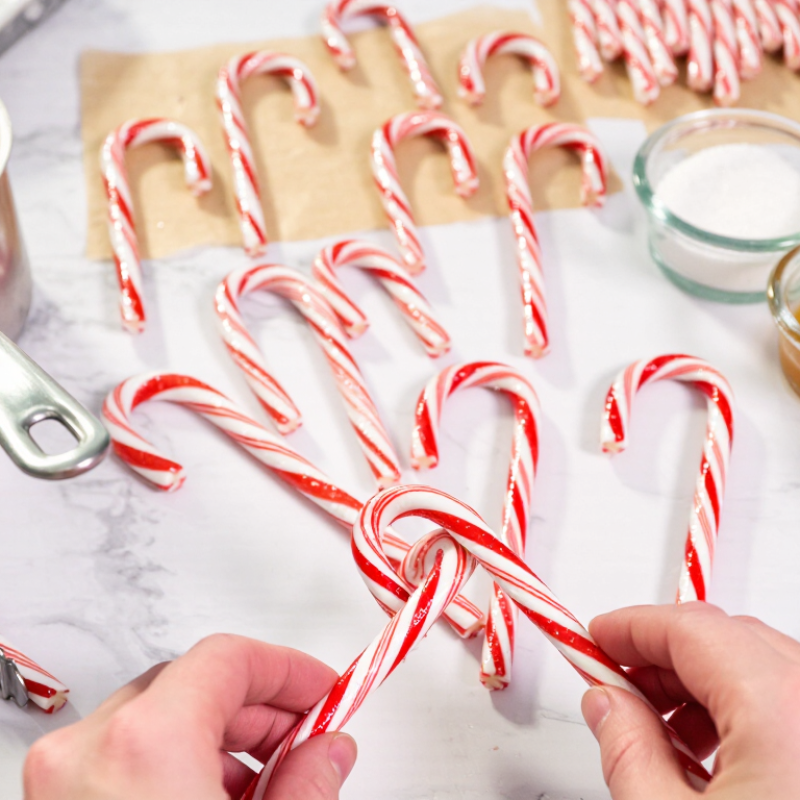
Candy Cane Scale: NCA Estimates 1.76 Billion Pieces Made Annually
Candy cane is a hard sugar confection shaped like a walking stick. Its familiar stripes come from colored candy dough twisted around a white center. The mixture usually contains sugar, corn syrup, water, flavoring, and food coloring. Manufacturers heat it until the syrup reaches a precise cooking temperature. Then, workers or machines pull and fold the hot mass, creating a glossy texture. It is still warm.
The National Confectioners Association estimates that about 1.76 billion candy cane pieces are made annually. That figure shows remarkable seasonal scale. It represents production, not necessarily final retail sales. The estimate also reflects industry reporting rather than a universal government census. That distinction matters. A large number can sound exact, even when production changes with weather, export demand, and holiday forecasts.
After cooking, the candy is divided into colored and uncolored portions. These portions are layered, stretched, and twisted into a long rope. Cutting machines then form individual pieces and bend one end. Cooling hardens the shape within minutes. Packaging protects the surface from humidity, which can make the candy sticky. Industry confectionery guidance treats moisture control as a key quality issue. Circana’s seasonal confectionery tracking also shows how strongly holiday demand influences category planning. Still, candy cane manufacturing is not perfectly uniform. Small differences in heat, pulling speed, or coloring can change the final texture. That is easy to overlook.
What Is Candy Cane Candy and How Is It Made?
Candy Cane Scale: Estimated Production Equivalents
The National Confectioners Association estimates that approximately 1.76 billion candy cane pieces are made annually in the United States. The shorter time periods shown here are mathematical equivalents of that annual estimate, assuming production is distributed evenly throughout the year.
Core Ingredients and the 300–310°F Hard-Crack Cooking Stage
Candy cane candy begins with a simple sugar syrup, but small temperature changes affect its final texture. A reliable base uses granulated sugar, corn syrup, water, and a little food coloring. Peppermint oil is usually added after cooking, when the syrup has cooled slightly. This protects its delicate aroma from excessive heat.
The critical stage is 300–310°F, known as the hard-crack stage. At this temperature, most water has evaporated, leaving a clear syrup that becomes brittle when cooled. Use a calibrated candy thermometer, and keep its tip away from the pan’s metal base. Do not guess. A few degrees can change a crisp candy into a sticky or scorched batch. Humid weather may also soften the finished pieces.
Timing matters. Pour the hot syrup onto a lightly greased, heat-resistant surface, then divide it carefully for coloring and flavoring. As the candy cools, it becomes thick but still flexible enough to pull and twist. Wear heatproof gloves, because molten sugar can cling to skin and cause serious burns. I once added peppermint oil too early, and the flavor nearly disappeared. That mistake taught me to remove the pan from heat before mixing it in. Work quickly, but avoid rushing the shaping process. Dry tools help prevent unwanted crystals. After forming, let the candy cool completely before wrapping it in moisture-resistant paper.
Coloring, Flavoring, and Cooling the Concentrated Sugar Syrup
What Is Candy Cane Candy and How Is It Made?
Candy cane production begins with a concentrated sugar syrup. Sugar, water, and glucose syrup are heated until the mixture reaches about 149–154°C, the hard-crack stage. At this temperature, most water has evaporated. The syrup becomes clear, glassy, and fragile after cooling.
Timing matters. Workers add flavoring after cooking, when excessive heat will not quickly destroy delicate peppermint notes. They divide the hot candy into portions, then mix food-safe color into selected pieces. A white rope joins a smaller colored rope. Pulling and folding creates a bright, fine stripe. It looks simple. It is not.
The National Confectioners Association reported approximately 54.2 billion dollars in U.S. confectionery sales during 2023. FAO’s Food Outlook projected global sugar production near 179.3 million tonnes for 2024/25. These figures show the scale behind a familiar seasonal product, but they do not guarantee consistent quality. Cooling conditions matter just as much. Candy may pass over cooling belts before being shaped and cut. High humidity can make the surface sticky, while rapid cooling can cause cracks.
From production observations, I find stripe alignment especially revealing. Uneven pulling changes the pattern within seconds. A slightly burnt syrup may still look attractive, yet its flavor exposes the mistake. That is where process control needs honest review. Temperature logs, calibrated sensors, and moisture checks support safer, more repeatable results, although handmade batches rarely look perfectly identical.
How Pulling and Twisting Create Candy Cane Stripes and Texture
What Is Candy Cane Candy and How Is It Made?
Candy cane begins as a cooked sugar mixture containing sugar, water, and corn syrup. The syrup reaches a precise high temperature, often near the hard-crack stage. It becomes glossy and thick.
Timing matters greatly. Too little heat leaves a sticky center. Too much heat creates brittle candy with a burnt taste. After cooking, the hot mass rests briefly on a heat-resistant surface. Flavoring and color are added while it remains workable.
The transformation starts with pulling. A candy maker stretches the warm sugar, folds it, and repeats the motion. Air enters the mixture, making the candy lighter and turning part of it opaque. The white section gains a smooth, satin-like appearance.
The red portion stays separate at first. It is colored, rolled into a narrow rope, and placed beside the white candy. Both ropes are then twisted together by hand or with a simple rotating machine. This creates the familiar spiral stripes. More twisting produces tighter lines; uneven pressure creates charming irregular bands.
The combined rope is stretched to a consistent thickness. It is cut into short pieces while still warm. Each piece receives a curved hook before cooling completely. Small temperature changes can alter the final texture. Even experienced makers sometimes pull unevenly, and that slight flaw can reveal the handmade process. Fresh candy should feel firm, clean, and crisp when broken.
Machine Forming, Hook Shaping, Cooling, and Retail Packaging
What Is Candy Cane Candy and How Is It Made?
Candy cane candy begins with sugar, glucose syrup, water, flavoring, and approved colors. The mixture is cooked under controlled heat until moisture drops and the mass becomes glassy. Candy makers often use vacuum cooking to reduce scorching and preserve a clean flavor. The National Confectioners Association reported approximately 48 billion dollars in U.S. confectionery retail sales in 2023. That figure shows why consistent forming and packaging matter, even for a seasonal product.
After cooking, the hot candy moves to a cooling table. Workers or automated pullers fold it repeatedly, creating a satin texture and distributing air. A white center and colored rope are then combined into a striped log. Machine forming reduces weight variation and produces a long, even cylinder. Cutting knives divide the rope into equal pieces. A forming unit rounds one end, while a hook-shaping tool bends it around a fixed guide. Timing is sensitive. Too much pressure can flatten the stripes.
Cooling follows immediately. Air tunnels lower the surface temperature and prevent sticky contact between pieces. Inadequate cooling remains a practical weakness, especially in humid rooms. Packaging machines then count, wrap, seal, and group the pieces for retail cartons. PMMI packaging research consistently identifies automation, hygienic design, and flexible changeovers as major equipment priorities. A 2024 confectionery market report from Mordor Intelligence also projects continued market growth, but forecasts are not guarantees. Real production still depends on sugar temperature, humidity, sanitation checks, and operator judgment. Sometimes, the machine needs correction.
What Is Candy Cane Candy and How Is It Made? - Machine Forming, Hook Shaping, Cooling, and Retail Packaging
| Production Stage | Main Ingredients or Equipment | Typical Operating Data | Purpose and Key Result |
|---|---|---|---|
| 1. Ingredient Preparation | Granulated sugar, glucose or corn syrup, water, food acid, and approved flavor and color ingredients | A sugar-based hard-candy formula; water is used to dissolve the dry ingredients and is largely removed during cooking | Creates the clear, glassy confectionery base required for a hard candy |
| 2. Cooking and Concentration | Steam-jacketed kettle or continuous candy cooker with temperature and vacuum controls | Common hard-candy cooking endpoint: approximately 145–155°C (293–311°F), depending on the formula and process | Reduces moisture and produces a low-moisture syrup that solidifies into a brittle candy |
| 3. Flavor and Color Addition | Food-grade flavoring, acidulant when required, and contrasting color portions for the traditional striped appearance | Ingredients are added after cooking or during controlled cooling to limit flavor loss and unwanted color changes | Develops the characteristic mint or other flavor profile and establishes the red-and-white visual pattern |
| 4. Cooling and Batch Preparation | Water-cooled table, cooling conveyor, batch rollers, and food-contact tools | The cooked mass is cooled until it becomes firm enough to handle but remains sufficiently plastic for forming | Prepares the candy mass for combining, rolling, and controlled shaping without excessive sticking |
| 5. Stripe Assembly and Rope Forming | White candy center, colored candy strips, batch former, rope sizer, and calibrated forming rollers | The layered batch is reduced into a continuous rope with a controlled diameter before cutting | Aligns the colored stripes and creates a uniform cross-section for consistent piece weight |
| 6. Machine Forming and Cutting | Rope sizer, rotary cutter, servo-driven forming unit, or batch roller and cutter | Cutting length and forming speed are adjusted to meet the target piece weight and finished dimensions | Produces repeatable candy pieces with a smooth surface and consistent size |
| 7. Hook Shaping | Hook-forming guides, dies, or synchronized mechanical shaping tooling | One end of each straight piece is curved while the candy is still warm and formable | Creates the recognizable cane shape while minimizing cracks, flattening, and stripe distortion |
| 8. Cooling and Setting | Cooling tunnel or controlled-temperature conveyor with sanitary air circulation | Cooling continues until the candy is fully hard, dry to the touch, and stable enough for packing | Locks in the hook shape and reduces the risk of deformation, sticking, or package damage |
| 9. Inspection and Weight Control | Visual inspection, checkweigher, metal detector, and sampling tools | Checks typically include piece weight, dimensions, stripe alignment, cracks, chips, surface defects, and foreign-material control | Confirms product consistency and supports food-safety and quality requirements |
| 10. Retail Packaging | Twist-wrap film, flow-wrap equipment, clear bags, cartons, labels, and date or lot coding equipment | Packaging is selected to protect the candy from moisture, dust, breakage, and handling damage | Extends shelf stability, provides product information, and prepares the candy for retail display |


